


Grahan Yoga in Kundali Is Misunderstood — Here Is What It Actually Does
Grahan Yoga is one of the most feared combinations in a birth chart — and one of the most consistently misread. The classical picture is far more nuanced.
Grahan Yoga in Kundali Is Misunderstood — Here Is What It Actually Does
Grahan Yoga (an eclipse combination in the birth chart, formed when the Sun or Moon conjoins Rahu or Ketu within the same house or within close degrees) is not a permanent mark of misfortune. According to Brihat Parashara Hora Shastra, planetary conjunctions — including nodal conjunctions — produce results that are deeply dependent on the house they occupy, the strength of the planets involved and the dasha (planetary period) that activates them. A Grahan Yoga in the 10th house of career produces entirely different results from one in the 4th house of home and mind.
A person finds "Grahan Yoga" in their chart during an online reading. The word grahan means eclipse. Immediately, a shadow falls over the entire chart. But the classical system never intended this combination to be read as a single, context-free verdict.
What Grahan Yoga Actually Is — and How It Forms
Grahan Yoga forms when the Sun (Surya) conjoins Rahu or Ketu in a chart, or when the Moon (Chandra) conjoins Rahu or Ketu. These are the two possible eclipse combinations because eclipses in astronomy occur when the Sun or Moon aligns with the lunar nodes (the points where the Moon's orbit crosses the ecliptic). Rahu is the north node and Ketu is the south node. When either luminary sits near these points in a natal chart, classical texts note the combination.
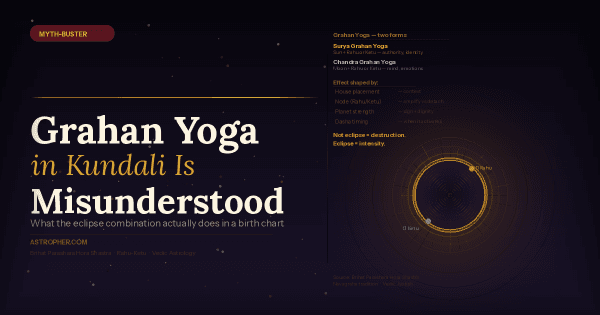
Surya Grahan Yoga (Sun conjunct Rahu or Ketu) and Chandra Grahan Yoga (Moon conjunct Rahu or Ketu) are the two forms most commonly discussed. Each has distinct characteristics because the Sun and Moon represent different things in a chart — the Sun governs the soul, authority, father and vitality; the Moon governs the mind, emotions, mother and nourishment.
Why the Fear-Reading Is Wrong
The popular interpretation of Grahan Yoga treats it as a kind of permanent eclipse of the planet it affects — as if the Sun's vitality or the Moon's emotional stability is simply blotted out for life. This reading borrows from the visual metaphor of an eclipse rather than from the actual mechanics of classical Jyotish.
Classical texts approach Grahan Yoga with considerably more nuance. Three factors determine how this combination actually expresses itself:
1. Which Planet Conjoins Which Node
Rahu amplifies and distorts the planet it conjoins. Sun conjunct Rahu often produces unusual ambition, a complex relationship with authority figures and a strong drive for recognition that runs deeper than the typical solar ego. It does not "eclipse" the Sun — it intensifies and complicates its expression.
Ketu, by contrast, is associated with past-life completion and spiritual detachment. Sun conjunct Ketu can produce a person who is genuinely indifferent to status or recognition — not because their vitality is diminished but because their relationship with solar themes (authority, public life, the father) has a quality of detachment or early completion. Many deeply spiritual practitioners carry Ketu conjunct Sun or Moon.
Moon conjunct Rahu produces emotional intensity and restlessness — a mind that reaches outward compulsively, often gifted with imagination and social intelligence but prone to dissatisfaction. Moon conjunct Ketu carries a different quality: emotional quietness, occasionally detachment from family or motherland, an inner life that processes deeply rather than expressively.
2. The House Placement
A Grahan Yoga in the 5th house (creativity, children, speculation) plays out very differently from one in the 8th house (transformation, hidden matters, longevity). The 5th house Grahan Yoga may produce an unusually creative mind with unconventional relationships with children or creative projects. The 8th house combination may produce fascination with the occult, research or hidden knowledge — all of which the 8th house governs.
Carrying this any further without knowing a specific chart becomes guesswork. For a precise reading of where Grahan Yoga sits in a particular birth chart and which houses and dashas it activates, a detailed Kundali analysis provides the actual planetary positions, not a category label.
3. The Strength of the Involved Planets
A Grahan Yoga formed by an exalted Sun conjunct Rahu in Aries produces very different results from a debilitated Sun conjunct Rahu in Libra. Classical texts consistently emphasise that the strength, sign and divisional chart (navamsha) placement of the involved planets modifies the yoga substantially. An exalted planet retains its core nature even under nodal influence.
The Dasha Timing Question
Even a significant Grahan Yoga in a birth chart does not produce its full effects continuously throughout life. The dasha system — which assigns each person a specific sequence of planetary periods — determines when a given yoga activates. A person may carry Chandra Grahan Yoga without experiencing its full intensity until their Moon mahadasha (Moon's major period) arrives, or during a Rahu or Ketu mahadasha.
This timing principle is central to classical Jyotish and is what separates it from natal determinism. The chart describes potential; the dasha system describes timing. A Grahan Yoga outside of its activating dasha is present but largely dormant.
The reverse is equally true and worth noting. During a Rahu or Ketu dasha, even a mildly placed nodal conjunction can become more prominent. This is why two people with similar Grahan Yogas in their charts may experience very different life trajectories — one was in a Rahu dasha during their peak professional years, the other was in a Jupiter dasha.
Famous Charts With Grahan Yoga
Classical Jyotish literature as well as modern astrological scholarship has noted Grahan Yoga in charts associated with unusually intense lives, unconventional achievements and transformative public presence. The combination is found in the charts of artists, scientists, spiritual leaders and social reformers — people whose lives carried an intensity that matched the combination's nature.
This does not mean Grahan Yoga guarantees such outcomes. It means the combination is associated with amplified experience — whatever the relevant house and planet governs tends to be lived more intensely, more unusually and with less of a straightforward, predictable arc.
The intensity is the point. The popular reading transforms that into catastrophe. The classical reading sees it as depth.
Grahan Yoga vs Kaal Sarp Dosha — A Common Confusion
A separate confusion worth addressing: Grahan Yoga is sometimes conflated with Kaal Sarp Dosha (the condition where all planets are positioned between Rahu and Ketu in the birth chart). These are different configurations entirely. Grahan Yoga involves the direct conjunction of a luminary with a node. Kaal Sarp Dosha involves the entire planetary arrangement — and even that combination is far more nuanced than popular reading suggests, as examined in the piece on why most people who think they have Kaal Sarp Dosh actually don't.
Conflating these two produces doubled anxiety without proportionally increased understanding.
What Grahan Yoga Asks For
Rather than a remedy to neutralise it, classical Jyotish's approach to Grahan Yoga is more accurately described as an invitation to understand the specific planet involved and develop a conscious relationship with its themes.
For Sun conjunct Rahu or Ketu: the work involves understanding one's relationship with authority, the father and public identity — typically complex, sometimes confusing, but often the source of the person's most distinctive traits.
For Moon conjunct Rahu or Ketu: the work involves understanding the emotional and mental nature — its restlessness, its depth or its unusual relationship with nourishment, belonging and the inner world.
These are not problems to fix. They are intensities to understand. The distinction between a problem and an intensity is, in classical Jyotish, everything.
Frequently Asked Questions
Q: What is Grahan Yoga in a Kundali?
A: Grahan Yoga forms when the Sun or Moon conjoins Rahu or Ketu (the lunar nodes) in a birth chart. It is named after the astronomical conditions that produce eclipses. The combination intensifies the planet involved rather than destroying it, and its effects depend heavily on house placement and dasha timing.
Q: Is Grahan Yoga bad in a birth chart?
A: Not inherently. Classical Jyotish texts describe Grahan Yoga as an intensifying combination, not an inauspicious one. Its effects depend on which planet is involved, which house it occupies, the strength of the planets and which dasha period activates the combination.
Q: What is the difference between Surya Grahan Yoga and Chandra Grahan Yoga?
A: Surya Grahan Yoga is the Sun conjunct Rahu or Ketu, producing effects related to authority, identity, vitality and the father. Chandra Grahan Yoga is the Moon conjunct Rahu or Ketu, producing effects related to the mind, emotions, nourishment and the mother. Both are distinct in nature.
Q: Does Grahan Yoga affect the entire life continuously?
A: No. Like all yogas in Jyotish, Grahan Yoga activates most strongly during the relevant dasha periods — particularly the Moon, Sun, Rahu or Ketu mahadasha. Outside these periods, the combination is present in the chart but largely dormant in expression.
Q: What is the remedy for Grahan Yoga?
A: Classical texts do not prescribe a single universal remedy for Grahan Yoga. General recommendations include Rahu or Ketu-specific worship depending on which node is involved, along with developing conscious awareness of the themes the affected planet governs. The combination is approached as depth to navigate, not damage to reverse.
Tags: