


Kaal Sarp Dosh: Why Most People Who Think They Have It Actually Don't
Kaal Sarp Dosh is one of the most feared formations in Jyotish — and one of the most frequently misdiagnosed. Here is what the actual definition requires.
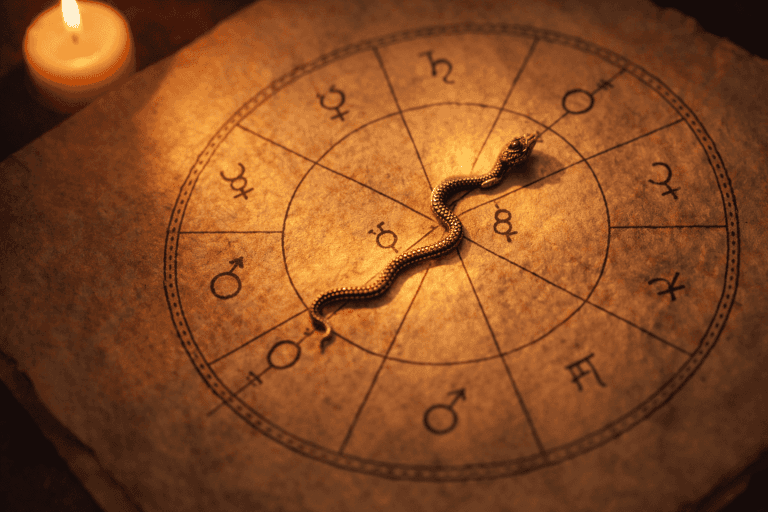
The pandit finished the chart reading in under fifteen minutes. "Kaal Sarp Dosh," he said, with a gravity that filled the room. "All your planets are trapped between Rahu and Ketu. This is why your career has stalled. This is why your marriage is delayed." The family nodded. The remedy package cost fourteen thousand rupees.
Three months later, a different astrologer looked at the same chart. Two of the seven planets sat clearly outside the Rahu-Ketu axis. There was no Kaal Sarp Dosh in that chart at all.
Kaal Sarp Dosh is one of the most misdiagnosed formations in popular Jyotish (Vedic astrology) today. Its definition requires a strict and specific condition — and most readings circulating in consulting rooms and online sessions fail to apply that condition correctly.
What Is Kaal Sarp Dosh and What Does It Actually Require?
Kaal Sarp Dosh occurs only when all seven classical planets — Sun, Moon, Mars, Mercury, Jupiter, Venus and Saturn — are fully enclosed between Rahu and Ketu in a birth chart, with no planet falling outside this nodal arc. If even one planet sits outside the Rahu-Ketu axis, the formation is incomplete. Most popular diagnoses fail to apply this strict condition, resulting in widespread misidentification.
Rahu and Ketu (the two lunar nodes — shadow points calculated from the intersection of the Moon's orbit with the Sun's apparent path) are always exactly opposite each other in a chart, 180° apart. Between these two points lies an arc of roughly 180° on one side. Kaal Sarp Dosh requires every classical planet to fall within that single arc — on the same side as the serpent's body — with none escaping to the other half.
The name itself is instructive. Kaal means "time" or "death." Sarp means "serpent." The formation is understood as a chart where the individual's planetary energies are enclosed within the coils of the cosmic serpent — creating a pattern of intense internal focus, karmic concentration and at times, a sense of life moving in constrained cycles. These are real qualities when the formation is genuinely present. They are not qualities to assign to every chart where Rahu and Ketu appear prominently.
The Diagnosis Problem — Where the Misreading Begins
The most common error in Kaal Sarp Dosh diagnosis is applying the label when only five or six planets fall within the nodal arc. A chart where Jupiter alone sits outside the axis is frequently still called Kaal Sarp Dosh in popular practice. It is not — at least not by the stricter classical definition. What exists instead is a partial hemming, which has different implications and is not the same formation.
The second common error is failing to check whether Rahu or Ketu themselves are conjunct a planet. Several classical scholars hold that if a planet is conjunct Rahu or conjunct Ketu — sitting directly on the nodal axis rather than enclosed within it — the formation is either absent or significantly modified. This condition affects a large number of charts and is routinely overlooked.
The One Rule That Changes Everything
The direction of the Kaal Sarp Dosh also matters — and this distinction is almost never communicated in brief consultations.
When all seven planets fall between Rahu and Ketu moving from Rahu towards Ketu in the zodiac's natural counter-clockwise direction, the formation is called Kaal Sarp Dosh. When the planets fall on the other arc — from Ketu towards Rahu — several classical traditions call it Kaal Amrit Dosh or Kaal Amrit Yoga, which carries a markedly different and sometimes more favourable interpretation. A chart diagnosed as Kaal Sarp without noting which direction the hemming runs is an incomplete diagnosis either way.
The detailed examination of what Kaal Sarp Dosh genuinely means when it is correctly identified — including its karmic significance and its potential as a yoga rather than purely a dosh — puts the full picture in context once the diagnostic question is settled.
What Classical Texts Actually Say About Kaal Sarp Dosh
The Brihat Parashara Hora Shastra (BPHS) — widely regarded as the foundational text of Jyotish — does not mention Kaal Sarp Dosh by name. Neither does the Brihat Jataka by Varahamihira, another primary classical authority. The formation appears in later astrological literature, with references found in texts like the Vashistha Samhita and various regional commentaries from the medieval period onward.
This does not mean Kaal Sarp Dosh is fictitious — but it does mean that different schools of Jyotish apply different definitions, and none of those definitions have the unambiguous classical authority that a BPHS citation would carry. Some scholars consider it a valid formation with karmic weight. Others regard it as a regional elaboration that grew in prominence through popular astrology rather than through classical scholarship.
The practical implication is that an astrologer who says "Kaal Sarp Dosh is causing all your problems" is operating from a relatively modern and contested framework, not from the same authoritative ground as a Vimshottari Dasha (the classical 120-year planetary period system described in detail in the BPHS) calculation. The two should not be presented with equal certainty.
The 12 Varieties and the Significance of Rahu's House Position
When the formation does genuinely appear in a chart, Jyotish identifies 12 varieties of Kaal Sarp Dosh based on the house Rahu occupies. Each variety carries a different name and a different area of focus. Rahu in the 1st house with Ketu in the 7th creates Anant Kaal Sarp, associated with identity and relationship tensions. Rahu in the 2nd house with Ketu in the 8th creates Kulik Kaal Sarp, touching wealth and ancestral patterns. Rahu in the 5th house with Ketu in the 11th is Padma Kaal Sarp, linked to children, creativity and networks.
Each variety deserves individual assessment based on the house lords involved, the planets enclosed and the active dasha (planetary period) in the individual's life. A one-size-fits-all remedy applied to all 12 varieties equally is not a classical Jyotish approach — it is a commercial one.
Ketu's role in this formation also deserves attention independently of the Kaal Sarp label. As the planet of karmic residue and spiritual separation in Jyotish, Ketu's placement and the patterns it shapes across past-life themes in a chart inform how the nodal axis operates regardless of whether the full Kaal Sarp formation is present.
Whether a chart contains a genuine Kaal Sarp Dosh — and which variety — is exactly the kind of question that a thorough birth chart (kundali) reading should address with precision before any remedy is discussed.
Frequently Asked Questions
Q: How do I know if I actually have Kaal Sarp Dosh in my kundali? A: Check whether all seven classical planets — Sun, Moon, Mars, Mercury, Jupiter, Venus and Saturn — fall entirely within the arc between Rahu and Ketu, with none falling on the opposite side. If even one planet sits outside this arc, the full formation is not present. A proper kundali analysis will show this clearly.
Q: Is Kaal Sarp Dosh mentioned in the Brihat Parashara Hora Shastra? A: No. The Kaal Sarp Dosh is not described in the Brihat Parashara Hora Shastra or in Brihat Jataka, the two most authoritative classical Jyotish texts. It appears in later astrological literature and regional commentaries, which is why different schools of Jyotish apply different definitions for it.
Q: Can Kaal Sarp Dosh be positive or beneficial? A: Several classical scholars hold that when the planets are hemmed from Ketu towards Rahu (the reverse direction), the formation functions more as a yoga — called Kaal Amrit Yoga — with spiritual intensity and eventual upliftment. Even the standard Kaal Sarp Dosh is associated with deep focus and karmic concentration, not purely with difficulty.
Q: Is a partial Kaal Sarp Dosh the same as a full Kaal Sarp Dosh? A: No. If one or two planets fall outside the Rahu-Ketu arc, the full formation does not exist by classical definition. Partial hemming carries different implications and should not be presented as Kaal Sarp Dosh — doing so leads to misplaced anxiety and misdirected remedies.
Q: What remedies are prescribed for genuine Kaal Sarp Dosh? A: Classical Jyotish recommends remedies based on the specific variety (determined by Rahu's house position), the active dasha and the individual's natal chart. Common recommendations include Rahu-Ketu related prayers, visits to Nag temples and specific mantras — but classical texts emphasise that remedies should be proportionate to the actual severity of the formation, which varies significantly across the 12 types.
The Dosh That Requires Precision, Not Panic
Kaal Sarp Dosh, when correctly diagnosed, is a real and significant chart formation. It does create a particular kind of karmic intensity — a concentrated, inward-turning energy that can manifest as cycles of effort and restriction before eventual breakthrough. That experience is worth understanding.
What is not worth anything is the fear attached to a label that was applied without checking whether the formation was present at all. The family that paid for expensive remedies for a dosh that did not exist in their chart was not protected by Jyotish. They were let down by a reading that skipped the most basic diagnostic step.
Classical Jyotish has always been a precision system. It asks for careful calculation before any interpretation begins. Kaal Sarp Dosh, perhaps more than any other formation, demonstrates why that precision matters — and what the cost of skipping it turns out to be.
Tags: