


Donating Black Items on Saturday: Genuine Remedy or Folk Superstition?
Donating black sesame, black cloth or urad dal on Saturday is one of India's most common Saturn remedies — but does classical Jyotish actually prescribe this?
Donating Black Items on Saturday: What Classical Jyotish Actually Says
Donating black items on Saturday has partial classical basis but has been significantly exaggerated in popular practice. Classical Vedic texts do associate Shani (Saturn) with dark colours, black sesame seeds and iron, and do recommend dana (charitable donation) as a Saturn remedy. The problem is not the principle but the execution — the practice has been stripped of its original conditions and turned into a blanket weekly obligation that classical texts never intended.
Every Saturday across India, families rush to donate black sesame (til), urad dal (black lentils), black cloth, mustard oil and iron to temple priests or under Peepal trees. The ritual has the feel of something ancient and authoritative. Whether it is actually grounded in classical texts is a more layered question than most people suspect.
What the Classical System Says About Saturn and Colour
Shani (Saturn, the slowest-moving planet in the Vedic system) is associated with specific material correspondences in texts like Brihat Parashara Hora Shastra and the Navagraha stotras. These correspondences include the colour black or dark blue, the metal iron, sesame seeds, mustard oil, black cloth and urad dal. This much is genuinely classical and not in dispute.
The correspondence system works as follows: each planet governs a set of materials, colours, grains, metals and deities. When a planet is afflicted in a chart — placed in a weak house, debilitated, or producing difficult transit effects — offering those planet's associated materials to the deserving acts as a symbolic act of propitiation and genuine charity.
The key word in that last sentence is "afflicted." The classical prescription for Saturn donation is not for everyone on every Saturday. It is for individuals whose Saturn is specifically creating difficulty — either through Sade Sati (the seven-and-a-half year transit of Saturn over the natal Moon and adjacent signs), Shani Dhaiya (a two-and-a-half year sub-transit) or through Saturn's placement in a difficult house in the natal chart.
The Compression Problem — From Conditional to Universal
This is where folk practice diverges from classical instruction. The original prescription was: if your Saturn is afflicted, donating Saturn's associated items on Saturday is a meaningful act of alignment with that planetary energy. Over generations of oral transmission, the conditional clause was dropped. What remained was: donate black items every Saturday.
That compression changes the entire nature of the practice. A person with a well-placed, strong Saturn in their birth chart — say, Saturn exalted in Libra ruling the 10th house of career — has no classical reason to perform Saturn appeasement rituals. Their Saturn is not creating difficulty. Performing weekly black-item donation for such a person is not classical Jyotish. It is anxiety management dressed as astrological practice.
The distinction matters because it shows how a sensible, context-specific instruction gets diluted into a superstition. The original logic was sound. The universal application is the problem. For anyone curious whether their Saturn actually needs attention, a free Kundali reading reveals Saturn's precise placement, strength and current transit effects in the birth chart — the starting point for any genuine Saturn remedy.
What Items Are Actually Prescribed — and Why
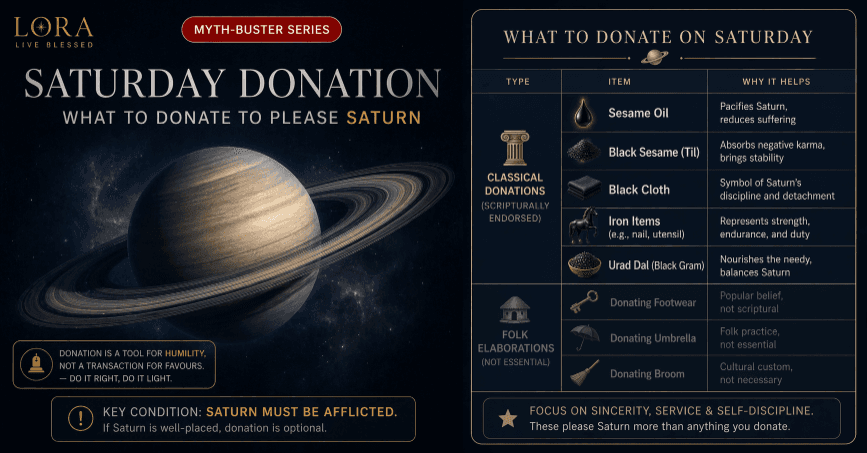
The most commonly cited Saturn donations in classical and semi-classical Jyotish literature are:
1. Black sesame seeds (kala til) — Among the most consistently mentioned across classical texts. Sesame has a specific place in Shraaddha (ancestral rite) traditions and is deeply associated with Saturn's domain over time, death and karmic accumulation.
2. Urad dal (black lentils) — Associated with Saturn in the grain correspondence system. Widely donated on Saturdays but its classical prescription is specifically for Saturn affliction contexts.
3. Iron — Saturn's metal. Donating iron implements to those who work with their hands — labourers, farmers, blacksmiths — is considered a meaningful Saturn offering in the Navagraha tradition.
4. Mustard oil — Traditionally used to light diyas (oil lamps) for Saturn and donated to the needy. The practice of lighting a mustard oil lamp at a Shani temple on Saturday has genuine classical roots.
5. Black cloth — The association is real but the practice of donating black cloth specifically to priests or temple trusts on every Saturday is a more recent folk elaboration rather than a classical prescription.
The items themselves are not the problem. The issue is the assumption that donating them every week without any understanding of whether one's Saturn is actually afflicted constitutes a meaningful remedy.
The Psychology Behind the Practice
There is a psychological dimension to Saturday black-item donation that classical Jyotish would recognise as legitimate even if the specific form has drifted. Saturn's domain includes discipline, service, humility and recognition of one's dependencies. The act of giving — genuinely giving to those in need — activates Saturn's positive qualities regardless of the recipient's astrological profile.
In this sense, the practice is not entirely without value. An act of genuine charity on Saturn's day, performed with awareness and without expectation of a transactional cosmic return, aligns with what classical texts describe as appropriate Saturn behaviour. The problem arises when donation becomes a transaction — "I give black sesame, Saturn stops troubling me" — rather than an expression of Saturn's virtues of discipline and humility.
Classical texts consistently caution against this transactional reading of remedies. The Phala Deepika (a 15th-century Jyotish text by Mantreswara) describes planetary remedies as acts of alignment with the planet's energy, not bargaining chips. A donation that comes from genuine compassion carries the energy of Saturn's highest expression. A donation performed out of fear or obligation carries only the performance.
This connects to a broader truth about how Vedic remedies function — examined carefully in the piece on whether astrological remedies instantly fix problems, where the classical position is both more nuanced and more honest than most practitioners communicate.
What Actually Helps During Saturn Transits
For someone genuinely experiencing a difficult Saturn period — Sade Sati, Shani Dhaiya, or a Saturn mahadasha (the major planetary period governed by Saturn, lasting nineteen years in the Vimshottari dasha system) — classical texts point to consistent practices:
Consistent charity to labourers, the elderly and the disabled carries significant weight in Saturn remedy traditions. These groups fall under Saturn's domain. Giving meaningfully to them, regularly and without fanfare, is more classically grounded than donating black sesame to a well-fed priest.
Hanuman puja on Saturday is widely recommended in popular tradition and has genuine roots — Hanuman is considered a protector against Saturn's more challenging effects in the popular Shaiva-Vaishnava tradition that developed around Jyotish practice.
Fasting on Saturdays — particularly avoiding non-vegetarian food and alcohol — is a classical recommendation during difficult Saturn periods. It is found in various Dharmashastra traditions and represents the sattvic (pure, clarifying) discipline that Saturn's nature rewards.
What This Means in Practice for 2026
In a year when Saturn transits Pisces (its current position through 2026), the individuals most likely experiencing genuine Saturn pressure are those with Moon, Ascendant or natal Saturn in Aquarius, Pisces or Aries. For these individuals, Saturn charity practices have classical grounding and genuine relevance.
For everyone else, black-item donation on Saturday is a cultural practice with partial classical roots that has been universalised beyond its original context. Performing it mindfully and charitably — giving real food to real people who need it — is always worthwhile. Performing it mechanically as a cosmic transaction every week, without knowing whether your Saturn is even creating difficulty, is simply habit dressed as remedy.
The classical system asks for awareness first. Everything else follows from that.
Frequently Asked Questions
Q: Is donating black items on Saturday a real Vedic remedy for Saturn?
A: Partially. Classical texts do associate black sesame, urad dal and iron with Saturn and recommend donation as a Saturn remedy. However, the classical prescription is specifically for people whose Saturn is afflicted — not a universal weekly obligation for everyone.
Q: What should you donate on Saturday for Shani?
A: Classical texts most consistently mention black sesame seeds, mustard oil, iron implements and genuine food donation to labourers, the elderly and the disabled. These are considered more authentic Saturn offerings than donating black cloth to temple trusts.
Q: Does donating on Saturday reduce Sade Sati effects?
A: Classical Jyotish considers genuine charity — particularly to Saturn-associated groups like the elderly, labourers and the disabled — as one of several Sade Sati remedies. It works as an act of alignment with Saturn's virtues of humility and service, not as a transaction that removes Saturn's effects.
Q: Which classical text prescribes Saturday black-item donation?
A: The association of Saturn with black sesame, iron and dark colours appears in Brihat Parashara Hora Shastra and Navagraha stotras. The Phala Deepika by Mantreswara discusses Saturn remedies as acts of alignment. No classical text prescribes blanket weekly black-item donation for all people regardless of their Saturn placement.
Q: Is it necessary to donate black items every Saturday?
A: Not according to classical Jyotish. The classical prescription is conditional on Saturn being afflicted in the birth chart or transit. For individuals with a well-placed Saturn, there is no classical basis for weekly Saturn appeasement rituals.
Tags: