


Rudraksha Is Not a One-Size-Fits-All Remedy — Mukhi Matters
Most people wear whichever Rudraksha is cheapest or most available — but the classical system built an entire science around the number of faces. Mukhi is everything.
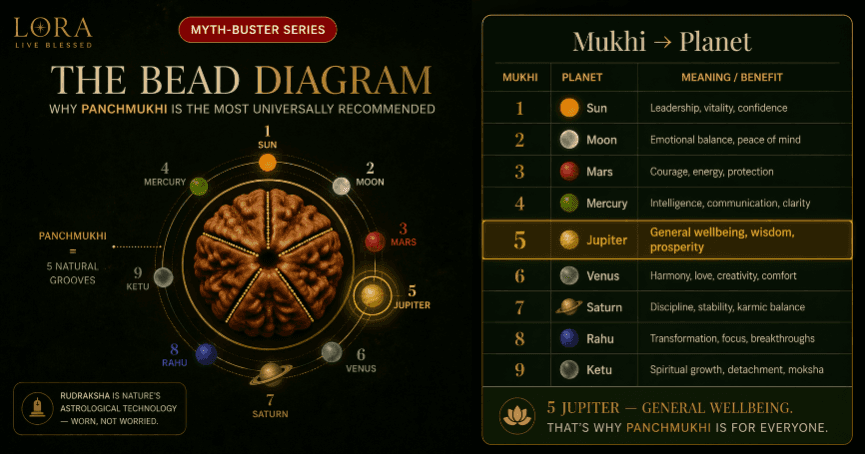
Rudraksha Is Not a One-Size-Fits-All Remedy — Mukhi Is the Specification
Rudraksha (the seed of the Elaeocarpus ganitrus tree, revered in Shaiva tradition) is not a universal spiritual accessory that benefits anyone who wears it. The number of mukhis — the natural ridged faces or divisions on the seed's surface — determines which planet, deity and life-area the bead addresses. According to the Rudraksha Jabala Upanishad, a classical Upanishadic text dedicated entirely to Rudraksha classification, each mukhi count carries a distinct correspondence. Wearing the wrong one for a specific need is not dangerous. It is simply inert for that purpose.
The single most common mistake in Rudraksha practice is treating the bead as a category rather than a system. A Rudraksha is not "a Rudraksha." A Saptamukhi (seven-faced bead) and a Dwiмukhi (two-faced bead) are as different in classical Jyotish as Saturn and the Moon.
What the Classical Texts Actually Map Out
The Rudraksha Jabala Upanishad and the Shiva Purana's Vidyeshwara Samhita both provide precise mukhi-to-deity-to-planet mappings. These are not decorative associations. They are the operational basis of the entire Rudraksha remedy system. The classical framework covers mukhis from one face through fourteen, though the most practically relevant range for Vedic remedies is one through nine — corresponding to the Navagraha (nine planets) of Jyotish.
The Nine Core Correspondences
1. Ek Mukhi (1 face) — Deity: Shiva. Planet: Sun (Surya). Classical use: authority, spiritual clarity, confidence, moksha (liberation). Genuine Ek Mukhi is rare and widely counterfeited — crescent-shaped South Indian variety and round Nepali variety both exist, with different properties in some traditions.
2. Dwimukhi (2 faces) — Deity: Ardhanarishvara (the unified Shiva-Parvati form). Planet: Moon (Chandra). Classical use: emotional stability, relationship harmony, mental equilibrium and mother-related wellbeing.
3. Teen Mukhi (3 faces) — Deity: Agni (fire god). Planet: Mars (Mangal). Classical use: releasing guilt, self-criticism and suppressed aggression. The classical texts address Mars's psychological dimension here — not just its physical associations.
4. Chatur Mukhi (4 faces) — Deity: Brahma. Planet: Mercury (Budh). Classical use: concentration, memory, articulate speech and analytical thinking. Often recommended for students and those in knowledge-based work.
5. Panchmukhi (5 faces) — Deity: Kalagni Rudra (a Shiva form). Planet: Jupiter (Brihaspati). Classical use: general wellbeing, wisdom, health and protection. This is the most widely available Rudraksha and the one most safely worn by anyone — because Jupiter is the natural benefic in Vedic astrology, its influence is broadly positive across charts.
6. Shanmukhi (6 faces) — Deity: Kartikeya (Skanda/Murugan). Planet: Venus (Shukra). Classical use: creativity, aesthetic sensibility, relationship fulfilment and material comfort.
7. Saptamukhi (7 faces) — Deity: Ananta (the cosmic serpent) and Mahalakshmi. Planet: Saturn (Shani). Classical use: financial stability, Saturn-related challenges and support during Sade Sati (the seven-and-a-half year Saturn transit period).
8. Ashtamukhi (8 faces) — Deity: Ganesha and the Ashta Matrikas (eight mother goddesses). Planet: Rahu (lunar north node). Classical use: removing persistent obstacles, breaking through inexplicable blockages and clearing Rahu-related confusion.
9. Navamukhi (9 faces) — Deity: Durga and the nine Shaktis. Planet: Ketu (lunar south node). Classical use: spiritual development, detachment from past conditioning and releasing Ketu-related karmic residue.
The pattern is unambiguous. Each Rudraksha is a targeted instrument. Wearing a Saptamukhi (Saturn) when the actual need is emotional stability (Moon) is not harmful — it is simply not addressing the right planetary energy.
Why Panchmukhi Became the "Any Rudraksha" Default
The conflation of Panchmukhi with "universal Rudraksha" is understandable in origin. Since Panchmukhi corresponds to Jupiter — who is considered the Guru (teacher and guide) of the planetary system and a natural friend to most Lagnas (ascendants) — it genuinely does confer broad benefit. It is also abundant, affordable and difficult to convincingly fake at scale because five ridges are easy to count and verify.
The problem is that this legitimate breadth of benefit got translated into a broader claim: that all Rudraksha work for all purposes. They do not. The classical system exists precisely because the Rishis who codified it understood that planetary energies are distinct and require distinct interventions.
Someone wearing an Ashtamukhi (Rahu bead) expecting Jupiter-like expansion is not using the remedy the tradition designed. They are wearing a bead associated with disruption, unconventional paths and Rahu's domain of desire and illusion — which may be precisely what is needed in some charts and entirely misaligned in others.
The Authenticity Problem the Texts Cannot Solve for You
Classical texts specify that only genuine, naturally formed Rudraksha seeds carry the properties they describe. This creates a practical challenge in 2026 that no scripture anticipated: the market for Rudraksha is heavily adulterated.
The Rudraksha Jabala Upanishad's descriptions assume a genuine seed from the Elaeocarpus ganitrus tree. Resin beads with painted faces, plastic imitations, and genuine seeds with artificially carved extra mukhis are all widely sold — particularly for rare counts like Ek Mukhi and high-mukhi beads where the price premium makes counterfeiting profitable.
The practical consequence is that bead authenticity must be verified before any classical benefit can be expected. For Panchmukhi, the risk is lower due to volume. For anything above seven mukhis, sourcing from verified traders with certificates of origin is not optional — it is the minimum condition for the remedy to function as the classical texts describe.
Using a Birth Chart as the Starting Point
The classical recommendation has always been chart-based. A Jyotish practitioner examining a Kundali (birth chart) identifies which Graha (planet) is afflicted, understrength or in need of strengthening — and then recommends the corresponding Rudraksha mukhi. The bead is a targeted support for a specific planetary pattern, not a general good-luck charm to be worn without context.
For someone experiencing persistent emotional turbulence rooted in a weak or afflicted Moon, a Dwimukhi is more relevant than a Panchmukhi, however safe the latter is. For someone in a difficult Saturn period with financial strain, Saptamukhi addresses the actual planetary cause. For someone whose chart shows Rahu prominently causing confusion and scattered focus, Ashtamukhi is the classical prescription.
Understanding which planet needs support in a specific chart — something that becomes visible through a detailed Kundali analysis — is the step that transforms Rudraksha from a decorative gesture into a functional Vedic remedy.
Mantra Activation — the Half the Bead Cannot Do Alone
The classical system considers a Rudraksha worn without mantra activation to be incomplete. The Shiva Purana specifies a purification and pranpratishtha (infusion of life energy) process before a Rudraksha is worn regularly. Each mukhi has its corresponding mantra: Ek Mukhi uses the Om Namah Shivaya root mantra or specific Surya beeja; Saptamukhi uses a Saturn-associated invocation; Ashtamukhi uses the Ganesh mantra.
The reasoning in classical texts is precise. A Rudraksha is a physical conductor of a specific energy. The mantra establishes the resonance between the bead, the corresponding planet and the wearer's subtle body. Without this step, the bead carries potential but no active current — like a circuit with an open switch.
This is where the broader principle of Vedic remedies applies. The remedy is not a passive object worn and forgotten. It is an active practice, sustained through awareness, intention and the correct associated mantra. The article on whether astrological remedies actually fix problems or require the wearer's participation explores this in greater depth — and the classical answer is more demanding and more intelligent than the passive version most people expect.
The Practical Summary
Rudraksha is a sophisticated remedial system, not a category of spiritual jewellery. The mukhi is the specification — it determines everything about what a bead is meant to address. Panchmukhi is the appropriate default for general use. Any other mukhi should follow from a clear understanding of which planetary energy needs support. The bead should be authentic, the source verifiable and the mantra activation treated as part of the remedy rather than an optional flourish.
Worn correctly, Rudraksha is one of the most accessible Jyotish remedies available — requiring no prescription, no metalwork and no auspicious timing more specific than a clean Monday morning. The condition is knowing which one. That single question is worth getting right.
Frequently Asked Questions
Q: Which Rudraksha is best for everyone?
A: Panchmukhi (five-faced) Rudraksha is the safest and most broadly beneficial choice for anyone without a specific planetary need. It corresponds to Jupiter, the natural benefic in Vedic astrology, and is recommended in the Rudraksha Jabala Upanishad for general health, wisdom and protection.
Q: Which Rudraksha mukhi corresponds to which planet?
A: Ek Mukhi — Sun; Dwimukhi — Moon; Teen Mukhi — Mars; Chatur Mukhi — Mercury; Panchmukhi — Jupiter; Shanmukhi — Venus; Saptamukhi — Saturn; Ashtamukhi — Rahu; Navamukhi — Ketu. These come from the Rudraksha Jabala Upanishad and Shiva Purana's Vidyeshwara Samhita.
Q: Can wearing the wrong Rudraksha cause harm?
A: Wearing a Rudraksha that does not match your specific planetary need is not harmful according to classical texts — it is simply ineffective for the intended purpose. The risk is not negative effect but missed opportunity: the correct mukhi remains unused while the wrong one is worn.
Q: Does Rudraksha need mantra activation before wearing?
A: Yes. Classical texts including the Shiva Purana specify a purification and pranpratishtha process before regular wear. Each mukhi has its corresponding mantra. A bead worn without this step is considered incomplete as a remedy in the Shaiva tradition.
Q: How do I know which Rudraksha mukhi I need?
A: The classical starting point is identifying which planet is afflicted or understrength in your birth chart. Panchmukhi is the appropriate default for general spiritual practice if no specific planetary concern has been identified through chart analysis.
Tags: