


Does Changing Your Name Really Change Your Luck?
Numerologists say adding a letter reshapes destiny. Classical Jyotish says something entirely different — and the evidence lives in the birth chart, not the spelling.
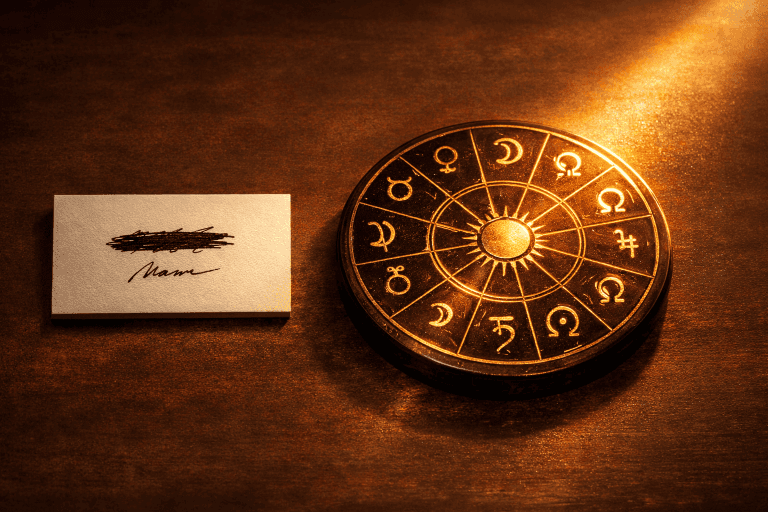
A film actor drops one letter from the surname. A trader adds an extra "a" to the business name. A sarkari naukri (government job) aspirant rewrites the first letter of the name before the exam result. When the career moves, the naming decision gets the credit.
The mind notices this pattern and files it carefully. What it does not file — with equal care — are the hundreds of identical name changes that preceded years of complete stillness.
Changing a name does not change luck in classical Jyotish (Vedic astrology). The birth chart — drawn from the exact time, date and place of birth — contains the planetary positions that shape personality, karma and the timing of life events. No change to a name's spelling or pronunciation alters those positions or the Vimshottari Dasha (the 120-year planetary period cycle) that governs the unfolding of a life.
Does Changing Your Name Really Change Your Luck? What Jyotish Says
Name changes do not alter luck according to classical Jyotish. The birth chart maps life patterns through planetary positions, not through the letters in a name. The Vimshottari Dasha cycle is calculated from the Moon's precise nakshatra (lunar mansion) position at birth — a fixed celestial coordinate that no adjustment to a nameplate, visiting card or legal document can touch.
What Name-Change Numerology Claims — and Where It Actually Comes From
The practice of changing a name to improve fortune draws from numerology — the belief that letters carry specific numerical frequencies that influence a person's life trajectory. The system most widely used in India today for this purpose is Chaldean numerology, originating in ancient Babylon, often blended with Pythagorean numerology from ancient Greece.
Neither of these systems is Jyotish. Neither has roots in the Vedas or in the classical astrological texts of India. They entered Indian practice through contact with Western occultism during the colonial period and were later absorbed into the commercial astrology market alongside — and often mislabelled as — Vedic practice.
The two systems can coexist. They should simply not be confused for the same tradition.
The Vedic Tradition of Names — What Classical Texts Actually Say
There is a genuine Vedic tradition linking names to celestial influence — but it operates very differently from what name-change numerologists describe. The Namkaran (Hindu naming ceremony) assigns the first syllable of a child's name based on the Janma Nakshatra — the lunar mansion the Moon occupied at the moment of birth. This practice is documented in the Grihyasutras (ancient texts governing household rituals) and remains widely observed across India.
The logic of Namkaran is that a child consistently addressed by a sound associated with their birth nakshatra grows up reinforcing the positive qualities of that nakshatra. The name becomes an environment of sound — present from the earliest moments of consciousness.
The Brihat Parashara Hora Shastra (BPHS) — the foundational text of Jyotish attributed to the sage Parashara — describes nakshatras in depth but contains no instruction for changing an existing name in adulthood to alter planetary outcomes. The classical tradition is about the name given at birth. It is not a prescription for adult name modification as a remedy.
An extra vowel added to a business card does not invoke the same tradition. The line between the two practices is significant.
Why the Success Stories Appear So Convincing
The stories feel persuasive because success after a name change is memorable and associable. The mechanics of the coincidence are considerably less romantic.
Dasha periods shift the quality of life markedly at natural transition points. A person entering a strong Jupiter dasha (Jupiter's 16-year planetary period) or a favourable Venus period after years of effort and frustration will experience visible improvement in career, finances or relationships. This shift arrives regardless of what is written on the nameplate.
The coincidence unfolds predictably. A person, feeling stuck in a difficult stretch, consults a numerologist. The numerologist recommends a name change. The change is made. Several months later, a dasha transition delivers a breakthrough. The name receives the credit for a planetary shift that was already scheduled.
The name did not cause the dasha. The dasha was already arriving.
This pattern — where a chosen intervention appears to produce an outcome that planetary timing was already generating — runs through the broader question of how remedies get credited for results they did not cause. The mechanics of that confusion are examined precisely in Do Astrological Remedies Instantly Fix Problems? What Jyotish Actually Teaches.
The Psychology Behind Why the Practice Persists
Psychology offers a parallel explanation that has nothing to do with planetary periods and everything to do with how the mind responds to deliberate change.
When a person changes their name — particularly publicly, on legal documents or business materials — they signal a fresh start to themselves. Identity and self-perception are closely connected to the name a person carries and how they are addressed. Research in social psychology consistently shows that deliberate changes to personal markers (name, appearance, environment) correlate with increased motivation, renewed effort and measurably better decision-making.
The improvement is real. The mechanism the numerologist described is not. A person who changed their name, felt renewed and then worked harder genuinely achieved more. The name change worked — through psychology, not planetary recalibration.
Jyotish is precise about where influence originates. The chart was drawn at the moment of birth and it does not update when the name changes in the gazetteer.
What the Birth Chart Reveals About Identity and Its Natural Timing
The 1st house (the house of self, body and public identity) and Mercury (Budh — the planet governing communication, language, names and how a person presents themselves to the world) are the two primary chart factors that describe identity-related experiences in Jyotish.
When Mercury is in a strong dasha or well-placed in the natal chart, personal branding and reputation flow naturally. When Mercury is afflicted — by Saturn's (Shani's) aspect or Rahu's conjunction — communication and public identity face periods of genuine friction. These patterns are readable and timed. They are not responsive to spelling changes.
Understanding which planetary period is active and how Mercury sits in the natal chart gives a far more actionable picture of when reputation and identity matters will move than any numerology consultation. A Kundali (birth chart) analysis maps Mercury's position, the active dasha and the 1st house configuration — revealing the actual timing of identity-related shifts in a person's life.
When Does a Name Change Have Legitimate Vedic Meaning?
One situation carries genuine classical logic. If a person's given name has no connection to the syllables associated with their Janma Nakshatra — due to regional convention, family tradition or practical circumstances at birth — a Jyotishi (Vedic astrologer) may consider whether a name aligned with the birth nakshatra's sounds would be more harmonious.
This is not about adding letters for luck. It is the original Namkaran logic applied thoughtfully and late. The assessment requires knowing the birth chart — particularly the Moon's nakshatra — not a numerical total derived from the name currently on file.
The difference between these two approaches is the difference between a classical practice and a commercial product that borrows its authority from one.
Frequently Asked Questions
Q: Does adding an extra letter to a name really improve luck? A: No. Classical Jyotish does not recognise spelling changes as a method of altering planetary influences or improving fortune. Success that follows a name change is more accurately explained by a simultaneous dasha transition in the birth chart or by the psychological motivation that a deliberate identity change produces.
Q: Is numerology the same as Vedic astrology? A: No. Numerology and Jyotish (Vedic astrology) are separate systems with distinct origins. Most name-change numerology practiced in India today derives from Chaldean or Pythagorean numerology — both Western in origin. Classical Jyotish uses planetary positions and nakshatra-based calculations, not the numerical values of letters.
Q: What does Vedic astrology say about the connection between names and destiny? A: The Namkaran ceremony connects a child's name to their Janma Nakshatra (birth nakshatra) — the lunar mansion the Moon occupied at birth. This is the classical Vedic link between names and celestial influence. It applies at the moment of naming at birth and is not extended in classical texts to adult name modification for luck.
Q: Why do some people seem to succeed after changing their name? A: Most cases coincide with a natural Vimshottari Dasha transition — a planetary period shift that improves life conditions regardless of any name change. Additionally, a deliberate name change creates a psychological fresh start: increased agency, renewed motivation and better effort — all of which independently produce better outcomes.
Q: Can a Jyotishi recommend a name change? A: A Jyotishi may assess whether a name aligns with the Janma Nakshatra as part of a birth chart reading — this is a legitimate classical consideration. Recommending a name change as a remedy for a dosha (planetary affliction) or a difficult dasha, however, has no basis in classical Jyotish texts.
Names, Numbers and the Chart That Does Not Move
There is a version of the name tradition that carries genuine Vedic roots — the Namkaran ceremony, which connects a child to their birth nakshatra from the very first sound they learn to respond to. That tradition deserves its place.
What deserves more scrutiny is the commercial extension: the extra vowel promised to resolve a Saturn period, the reordered syllable guaranteed to attract wealth, the revised nameplate sold as an alternative to reading the actual chart.
The birth chart holds the map of why life is moving as it is. That map does not redraw itself when the name on the letterhead changes.
Tags: