


How to Set Up and Decorate Your Home Mandir for Akshaya Tritiya 2026 — A Complete Puja Guide
A room-by-room guide to decorating your home mandir and performing Radha-Krishna puja this Akshaya Tritiya — with flower choices, offering sequences and the classical meaning behind each element.
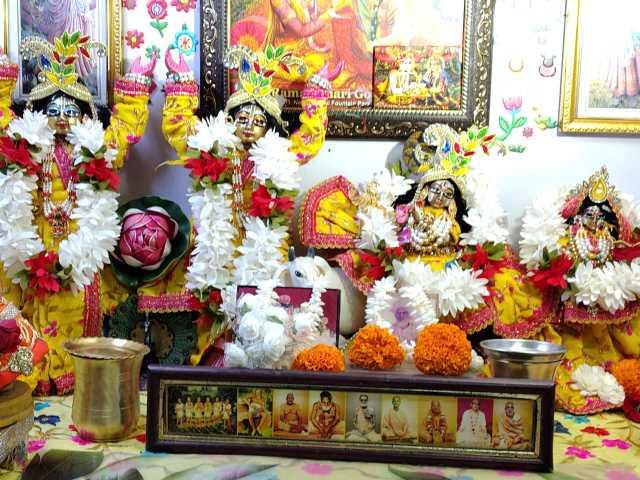
The marigolds are arranged. The white mogra (jasmine) garlands are draped across the deities. The brass kalash (sacred water vessel) sits on the left, ready. A pink lotus rests at the centre — offered not because someone read it in a book, but because this family has offered one every Akshaya Tritiya for as long as anyone can remember.
That continuity — the unbroken thread of home worship — is precisely what Akshaya Tritiya (falling on April 19, 2026, the Vaishakha Shukla Tritiya) is designed to honour and deepen.
A home mandir (home temple) is not a smaller version of a public temple. It is a living space of daily worship that, on festival days, becomes a focal point of the household's collective devotion. Decorating it with care on Akshaya Tritiya is itself a form of seva (devotional service) — and the classical tradition offers precise guidance on how to do it well.
Why the Home Mandir Holds Special Significance on Akshaya Tritiya
Akshaya Tritiya is one of the four Swayamsiddha Muhurtas (self-auspicious moments requiring no separately calculated electional timing) in the Hindu calendar — making it the ideal day to begin new spiritual practices, refresh the home mandir setup or install new deity murtis (sacred images).
The Skanda Purana describes the punya (spiritual merit) of devotional acts performed on this tithi as akshaya — imperishable, never diminishing. This applies directly to home worship. Establishing a new puja routine, placing fresh deity murtis, performing a systematic shodashopachara puja (sixteen-step puja sequence) or simply cleaning and rearranging the mandir with intention on Akshaya Tritiya sets the quality of that worship as a foundation going forward.
Radha-Krishna (Radha — the supreme devotee and consort of Lord Krishna; Krishna — the eighth avatar of Vishnu and the deity of divine love and cosmic order) is among the most widely worshipped deity pairs in home mandirs across North and Central India. The yellow silk attire traditionally used for their murtis on festival days carries the colour of Vaishakha — the spring month associated with abundance and new beginnings.
Flower Choices for the Home Mandir — What Each Offering Means
The flower arrangement in a home mandir is not merely decorative. Each bloom carries a specific classical association in Vaishnava puja tradition.
White flowers (mogra, jasmine, white chrysanthemum) — associated with purity, sattvic (clear and calm) energy and the Moon. White garlands draped across Radha-Krishna murtis are particularly auspicious on Ekadashi and on full moon days. On Akshaya Tritiya, white flowers signal clarity of intention in new beginnings.
Marigold (genda phool) — the most widely used flower in Indian puja, associated with the Sun and with auspicious new starts. The deep saffron and orange marigold, placed in clusters before the mandir, is considered highly pleasing to Vishnu and his avatars. Their bright colour also carries symbolic significance: the same warmth as the Vaishakha sun.
Lotus (kamal) — among the most sacred offerings in the Vaishnava tradition. The pink lotus is associated with Lakshmi (the goddess of abundance and auspiciousness, consort of Vishnu) and is described in the Bhagavata Purana as Vishnu's preferred flower. Offering a single fresh pink lotus on Akshaya Tritiya — placed at the centre of the mandir as seen in traditional home setups — carries profound classical weight.
Red flowers (red roses, red hibiscus) — associated with Shakti, devotion and the intensity of love. In Radha-Krishna worship, red flowers represent the rasa (divine emotion) of love — placed as a reminder that devotion itself is the offering.
How to Arrange the Home Mandir for Akshaya Tritiya
Cleaning and Preparation
The first act of festival puja is cleaning — both the mandir space and the devotee's own preparation. Wiping the mandir shelf, washing the brass vessels (kalash, puja thali, incense holder), polishing the murti bases and laying fresh cloth or asana (the fabric base on which murtis rest) is considered the first form of seva for the day.
Classical texts recommend using fresh yellow or white cloth on Akshaya Tritiya — yellow for its association with the season and with Vishnu's solar energy, white for purity of intent.
The Deity Setup
In a traditional home Radha-Krishna mandir, Radha stands or sits to Krishna's left (from the deity's perspective, which means to the right as seen by the worshipper). Balancing the visual weight of the two murtis with equal garlands and equal care in decoration is itself a form of respect for the relationship the two deities represent.
If a small white cow (Nandi or Kamdhenu) or other sacred animal figure is part of the setup, it is traditionally placed at the feet of the deities — not between them — as a symbol of the divine abundance that flows from devotional practice.
The guru parampara (lineage of teachers) photos or framed images, if present in the mandir, are placed with equal reverence — slightly to the side of the principal deities, never higher. They represent the human channel of divine teaching and are honoured as part of the same worshipped space.
The Puja Sequence
The classical shodashopachara puja (sixteen-offering sequence) is ideal for Akshaya Tritiya but can be simplified without losing its essence. The core sequence for a home puja on this day:
- Avahana — inviting the deity's presence with folded hands and a brief prayer
- Snana — ritual bathing of the murti (or sprinkling of Ganga jal / sacred water) followed by fresh clothing
- Pushpa — offering fresh flowers, beginning with the lotus if available
- Dhoop — lighting incense (agarbatti) — sandalwood or mogra fragrance is traditional for Vaishnava worship
- Deepa — lighting the ghee diya (lamp), ideally with five wicks for festival days
- Naivedya — offering food: traditionally panchamrita (a mixture of milk, curd, honey, ghee and sugar), fresh fruits and a sweet like mishri (rock sugar) or kheer (rice pudding)
- Pradakshina and Pranama — circumambulation (walking around the mandir) and prostration, followed by aarti
The final and most important offering on Akshaya Tritiya is dana (charitable giving) performed after the puja — food, grain or resources given to those in need. Classical texts describe this as the act that seals the akshaya (imperishable) quality of the day's merit.
What to Keep Near the Mandir on Akshaya Tritiya
Three items that carry particular classical significance on this day:
A brass kalash (sacred vessel) filled with water, a coconut placed on top and mango leaves arranged around the neck of the vessel — the classical symbol of auspicious beginnings. Placing this to the left of the deity on Akshaya Tritiya is described in the Bhavishya Purana as establishing abundance in the home for the year ahead.
Tulsi (holy basil) — considered the most sacred plant in Vaishnava tradition and described in the Bhagavata Purana as inseparable from Vishnu's worship. A fresh tulsi sprig placed before the deity on Akshaya Tritiya is considered an offering that Vishnu accepts with particular grace.
A photo or framed image of one's lineage teachers (guru parampara) — a reminder that home worship is not practised in isolation but within a living tradition of transmission. Lighting a small lamp before the guru parampara image before beginning the main puja is a classical practice in Vaishnava households.
Frequently Asked Questions
Q: What is the best time to perform puja on Akshaya Tritiya 2026? A: Akshaya Tritiya 2026 falls on April 29. Since it is a Swayamsiddha Muhurta, any time during the Tritiya tithi is considered auspicious — no separate muhurta calculation is required. The traditional recommendation is to complete the main puja before noon (before the Sun crosses the midheaven), with the morning hours being especially auspicious.
Q: Which flowers are most auspicious for Radha-Krishna puja on Akshaya Tritiya? A: The lotus (kamal) is considered the most sacred offering for Radha-Krishna worship, particularly the pink lotus associated with Lakshmi. White jasmine (mogra), marigold and red flowers are also traditionally used. The classical principle is freshness — whatever is offered should be clean, fresh and offered with intention.
Q: Can new deity murtis be installed in the home mandir on Akshaya Tritiya? A: Yes. Akshaya Tritiya is one of the most auspicious days in the Hindu calendar for murti pratishttha (installation of deity images) in a home mandir. Its Swayamsiddha Muhurta status makes it ideal for beginning new worship relationships. A simple prana pratishtha (invocation of divine presence into the murti) performed with water, flowers and mantras is sufficient for a home installation.
Q: Is it necessary to fast on Akshaya Tritiya? A: Fasting on Akshaya Tritiya is a personal devotional choice, not a universal requirement. Classical texts describe the day as auspicious for charitable giving and worship rather than prescribing a mandatory fast. Many devotees observe a partial fast or eat only sattvic (simple, pure) food. The emphasis of classical texts is on dana (giving) and puja rather than on personal restraint.
Q: What should be offered as naivedya (food offering) on Akshaya Tritiya? A: Traditional naivedya for Akshaya Tritiya includes panchamrita (a blend of milk, curd, honey, ghee and sugar), fresh seasonal fruits, mishri (rock sugar) and a sweet preparation such as kheer or halwa. In Radha-Krishna worship, offerings of makhan (white butter) and misri are also traditional — connected to the devotional iconography of young Krishna.
The Home Mandir as a Living Practice
A well-kept home mandir is not measured by the scale of its decoration or the number of its murtis. It is measured by the consistency of the attention given to it and the intention carried into each act of worship.
Akshaya Tritiya is an invitation to begin or renew that consistency — to clean the mandir with care, to offer what is fresh and available, to sit for a few minutes in the morning before the deities and let the quality of the day settle into the rhythm of home life.
The lotus placed at the centre, the marigolds arranged with attention, the brass kalash filled with clean water — these are not performances. They are the accumulated expression of a household's ongoing conversation with the sacred. The Akshaya quality the classical texts speak of belongs to that conversation, not to any single object placed within it.
Tags: