


The First Meeting of Hanuman and Rama
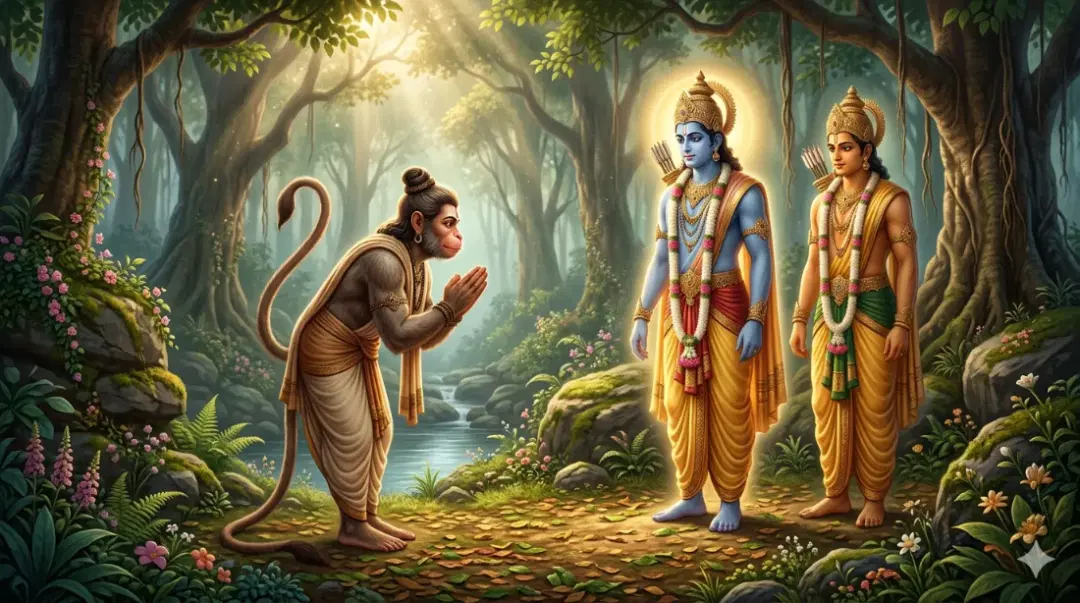
The quiet yet powerful first meeting of Hanuman and Rama reveals more than devotion it reveals recognition.
When Recognition Feels Like Destiny
Some meetings feel strangely familiar, as if they were always meant to happen. Not dramatic, not loud—just deeply certain. The first meeting between Hanuman and Rama carries this exact quality. It does not begin with miracles or war, but with a quiet conversation. And yet, something within that moment shifts the entire direction of the Ramayana.
This is not just a story of devotion. It is a story of recognition.
The Setting: A Forest, A Search, A Question
Rama and Lakshmana were wandering through the forests of Kishkindha, searching for Sita. Their journey had already moved beyond personal loss into something deeper—a test of patience, purpose, and dharma (righteous duty).
At the same time, Hanuman stood as a minister to Sugriva, the vanara king in exile. He was not yet the legendary devotee people remember today. He was intelligent, observant, and cautious.
Something unusual was about to unfold.
A Disguise That Revealed Truth
Hanuman approached Rama and Lakshmana not in his original form, but disguised as a humble brahmin. This choice was not accidental. It reflects a psychological truth—before trust is built, the mind seeks safety.
He asked simple questions. Who are you? Why are you here in this forest?
Yet beneath those questions was a deeper observation. Hanuman noticed their calmness, their dignity, their quiet strength. These were not ordinary men.
And then, something subtle shifted.
The Moment That Changed Everything
As Hanuman listened to Rama speak, his inner clarity awakened. The Ramayana, particularly Valmiki’s version, describes this moment not as realization through logic, but through anubhava (direct experience).
Hanuman did not “decide” to serve Rama.
He recognized him.
This distinction matters.
What Did Hanuman Actually See?
From a Vedic lens, this moment reflects the concept of atma pehchan (soul recognition). Hanuman was not drawn by power or status. He was drawn by alignment.
In modern terms, it is similar to meeting someone whose presence instantly calms the mind. No explanation needed.
This is where the story quietly deepens.
Because Hanuman, despite his strength and intelligence, had forgotten his true potential something explored beautifully in how Jambavan later awakened his power, a moment that completes this journey of recognition and inner awakening.
That first meeting with Rama planted the seed for that awakening.
A Short Exchange, A Lifelong Devotion
Hanuman introduced Rama to Sugriva. That was his duty. But what followed was far beyond duty.
Devotion in Indian thought is rarely instant attachment. It grows through understanding. Hanuman observed Rama’s actions, his patience, his commitment to dharma even in suffering.
Slowly, service became natural.
And then, irreversible.
A Subtle Psychological Truth
This story reflects a deeper human pattern.
People do not commit deeply because they are told to. They commit when they feel aligned. Whether in a career, a relationship, or even a sarkari naukri (government job), true dedication comes from inner resonance, not external pressure.
Hanuman’s devotion was not blind. It was aware.
Myth vs Reality: Was It Love at First Sight?
A common belief is that Hanuman instantly became a devotee the moment he saw Rama.
This is only partially true.
The Reality:
Devotion began with curiosity, moved through observation, and settled into surrender.
This progression matters because it removes the myth of blind faith. Vedic tradition does not demand instant belief. It encourages understanding first.
A similar clarity is explored in how astrology itself is often misunderstood:
Just as astrology is not about prediction but interpretation, Hanuman’s devotion was not impulse but realization.
The Deeper Symbolism
Hanuman represents the mind.
Rama represents higher consciousness.
Their meeting symbolizes the moment when the restless mind finds something worthy of anchoring to.
This is why Hanuman’s strength becomes limitless after this connection. Not because he gained power, but because his direction became clear.
And that changes everything.
A Question That Quietly Lingers
Why did Hanuman, among all beings, recognize Rama so quickly?
Classical texts hint at karmic continuity. Some connections are not built in one lifetime. They are resumed.
This is where personal patterns matter.
Even today, understanding one’s own tendencies and life patterns through a detailed birth chart can reveal why certain people or paths feel instantly right. A deeper kundali analysis often brings this clarity into focus, especially when decisions feel emotionally confusing yet intuitively certain.
What This Story Means in Today’s Life
The story is not asking anyone to become like Hanuman in devotion.
It is asking something simpler.
To notice where genuine alignment exists.
In modern life, this could mean:
- Choosing a career that feels meaningful, not just stable
- Building relationships that feel calm, not just exciting
- Trusting instincts when something feels quietly right
These are small decisions, but they shape long-term direction.
When the Mind Finally Finds Its Anchor
Hanuman did not become extraordinary in that first meeting. He became clear.
And clarity is often more powerful than strength.
The meeting between Hanuman and Rama reminds that destiny is not always loud. Sometimes it begins with a conversation, a question, or a feeling that cannot be explained.
Not every meeting is meant to change life.
But some are meant to reveal it.
Tags: