


Maa Vaishno Devi Story: Divine Origin, Bhairavnath Legend & Spiritual Significance of Trikuta Hills
The sacred story of Maa Vaishno Devi represents the combined divine powers of Mahakali, Mahalakshmi, and Mahasaraswati. Born as Trikuta, she undertook deep penance and ultimately defeated Bhairavnath, granting him salvation. Today, she resides in the holy cave of Trikuta Hills in the form of three sacred pindis, attracting millions of devotees seeking blessings and spiritual fulfillment.
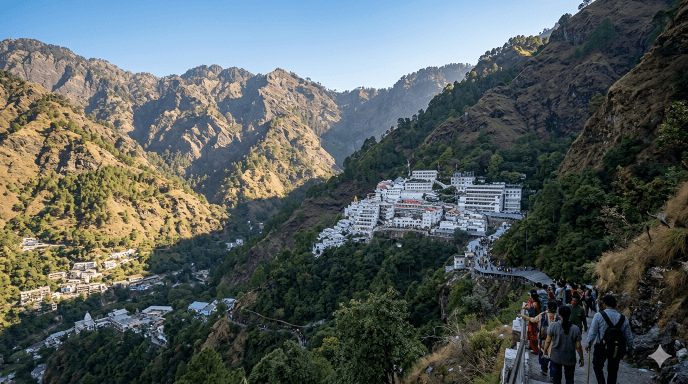
Maa Vaishno Devi is one of the most revered Hindu deities, worshipped as the embodiment of divine feminine energy. Her sacred shrine, located in the Trikuta Hills of Jammu, is among the most visited pilgrimage sites in India. The story of Maa Vaishno Devi is deeply rooted in Hindu mythology and represents the union of three powerful goddesses—Mahakali, Mahalakshmi, and Mahasaraswati.
Divine Birth and Purpose
According to Hindu scriptures, during the Treta Yuga, when evil forces and demons began to dominate the Earth, the three supreme goddesses—Mahakali, Mahalakshmi, and Mahasaraswati—combined their divine energies to create a powerful spiritual force. This energy took birth as a divine girl named Trikuta.
She was born to Ratnakar, a devout follower, in South India. From a young age, Trikuta exhibited extraordinary spiritual inclination and dedicated herself to meditation and devotion.
Trikuta and Her Devotion
Trikuta was a staunch devotee of Lord Vishnu and wished to marry him. However, Lord Vishnu, recognizing her divine purpose, advised her to continue her spiritual journey and fulfill her destiny of protecting the world from evil.
Accepting this, Trikuta embraced a life of penance and righteousness.
Encounter with Bhairavnath
A tantric ascetic named Bhairavnath became obsessed with Trikuta’s divine beauty and spiritual power. He began to pursue her with ill intentions.
To escape him, Trikuta traveled northwards towards the Himalayas, eventually reaching the Trikuta Hills in present-day Jammu.
Miracles Along the Journey
During her journey, Maa Vaishno Devi performed several miracles:
- Creation of Banganga: She shot an arrow into the ground to release water, now known as Banganga, to quench her thirst.
- Charan Paduka: A sacred spot where her footprints are believed to be imprinted.
- Adhkuwari Cave (Garbh Joon): She meditated in this cave for nine months, symbolizing rebirth and spiritual purification.
Meditation in the Holy Cave
To escape Bhairavnath, Trikuta entered the Adhkuwari cave and performed intense meditation for nine months. This period is often compared to the cycle of human birth, symbolizing spiritual rebirth for devotees who pass through the cave.
The Slaying of Bhairavnath
When Bhairavnath finally discovered her location and attempted to enter the cave, Maa Vaishno Devi assumed the fierce form of Mahakali and beheaded him.
His head fell at a distant location, which is now known as the Bhairav Temple.
Granting Salvation to Bhairavnath
Before dying, Bhairavnath realized his mistake and sought forgiveness. Demonstrating compassion, Maa Vaishno Devi granted him moksha (liberation) and declared that her pilgrimage would remain incomplete without visiting Bhairavnath’s temple.
This tradition continues to this day.
Transformation into Pindis
After fulfilling her divine mission, Maa Vaishno Devi transformed herself into three sacred pindis (natural rock formations) inside the holy cave. These represent:
- Mahakali – Power and destruction of evil
- Mahalakshmi – Wealth and prosperity
- Mahasaraswati – Knowledge and wisdom
These pindis are worshipped by millions of devotees visiting the shrine.
Story of Pandit Shridhar
Another popular legend states that Maa Vaishno Devi appeared in the dream of a poor Brahmin, Pandit Shridhar. She guided him to organize a grand feast (Bhandara), where she revealed her divine presence and helped discover the sacred cave.
The story of Maa Vaishno Devi is a powerful blend of devotion, courage, and compassion. From her birth as Trikuta to her transformation into sacred pindis, every aspect of her journey inspires millions. Her victory over evil and her kindness in granting salvation to Bhairavnath symbolize the eternal triumph of good over evil.