


The Great Churning: Samudra Manthan and the Quest for Immortality
One of the most significant episodes in Puranic mythology is the Samudra Manthan, or the Churning of the Ocean of Milk, where we find a unique instance of collaboration between the Devas and the Asuras in the quest for the nectar of immortality, or Amrita. The episode is a metaphor for the human quest for enlightenment, or the churning of the human mind, and the equilibrium between the conflicting forces of nature.
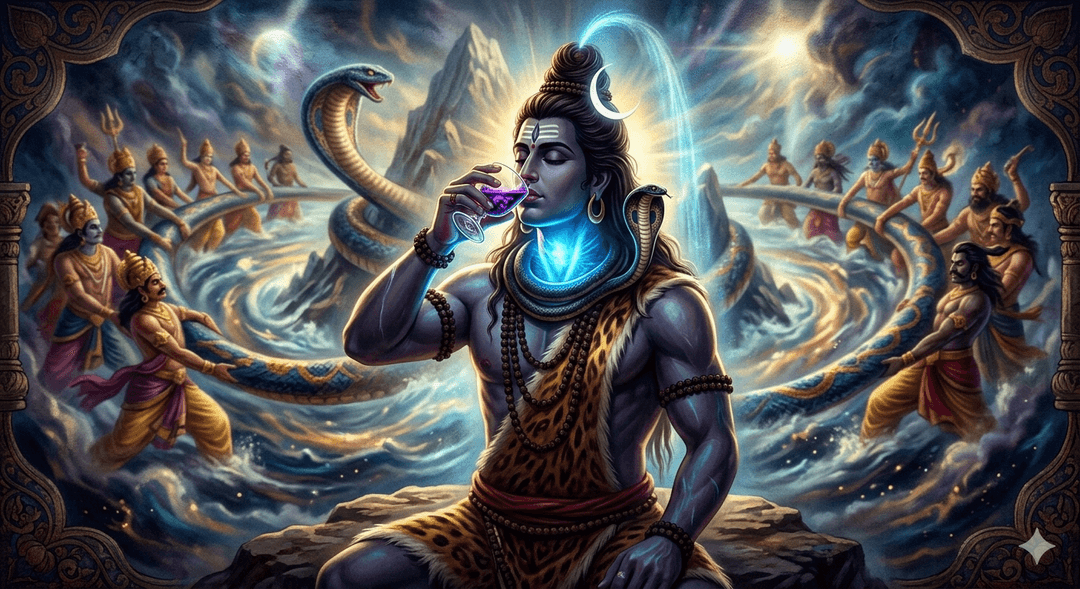
The Divine Crisis
The story begins in a crisis of power. The Devas had lost their power and luster owing to a curse from the short-tempered Sage Durvasa, and the Asuras had gained power and taken over the universe. On the advice of Lord Vishnu, the Devas entered into a temporary alliance with the Asuras to churn the Kshira Sagara(Ocean of Milk), which would produce the Amrita Kalasha, giving them eternal life and power.
The Churning Mechanism
To churn an ocean, one would need more than just simple equipment. The equipment they used was:
Mount Mandara: This was the churning rod (Manthana).
Vasuki: The King of Serpents, who was the churning rope.
Kurma Avatar: When the mountain was sinking into the ocean, Lord Vishnu appeared in the form of a giant tortoise (Kurma) to support the mountain on his back.
The Emergence of Halahala
Prior to the emergence of any treasures, the ocean gave birth to Halahala, a deadly poison so powerful that it had the potential to destroy everything on earth. Neither gods nor demons could breathe in its vapors. In a final act of sacrifice, Lord Shiva swallowed the Halahala. His consort, Parvati, held his throat so that the Halahala did not spread and infect his body. This resulted in his throat turning blue and earned him the nickname Neelkanth, or The Blue Throated One.
The Fourteen Ratnas (Gems)
As the churning continued, fourteen divine treasures (Ratnas) came out of the depths of the ocean. These included:
- Lakshmi: The Goddess of Wealth, who chose Vishnu as her eternal consort.
- Airavata: The four-tusked white elephant that belonged to Indra.
- Kamadhenu: The wish-fulfilling cow.
- Uchaihshravas: The divine seven-headed horse.
- Parijat: The celestial flowering tree.
- The Moon (Chandra): Which Shiva took to adorn his hair.
Understanding the 14 Ratnas of the Samudra Manthan
The Appearance of Amrita
Finally, Dhanvantari, the physician of the gods, appeared with his gold vessel of Amrita. There was a fierce contest between the Devas and the Asuras over the possession of the nectar. To see that the nectar reached the gods, Vishnu took the form of Mohini, an enchantress, and deceived the Asuras and handed over the drink to the Devas.
Philosophical Significance
The Samudra Manthan has been metaphorically used to represent Yoga and Meditation. The ocean here represents the human mind, the mountain represents concentration, and the churning process represents the constant struggle between positive and negative thoughts. The poison here represents all negative thoughts like anger, ego, greed, and so on, which need to be "swallowed" before one can attain the "nectar" or peace of mind.