


Dashavatar and Darwin: Are the Two Theories Surprisingly Connected?
Can an ancient Hindu myth explain modern biology? Discover the fascinating parallels between Lord Vishnu's Dashavatar and Charles Darwin's Theory of Evolution
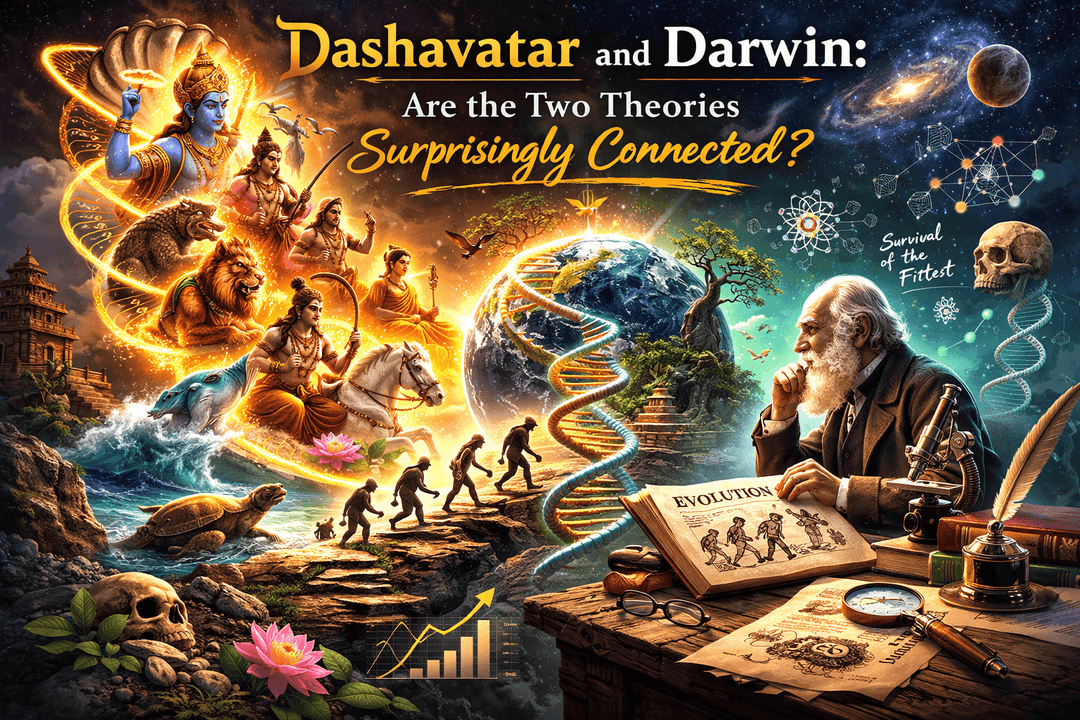
In the 19th century, Charles Darwin stunned the world with his Theory of Evolution. He proposed that life began in the water, slowly adapted to land, evolved into early human forms, and eventually became the complex beings we are today. For the Western world, this was a massive disruption to traditional thinking.
In India, you can find a similar story of how life progressed, but it's not from science studies. Instead, it's from the verses of old myths.
If you take a closer look at the ten avatars of Lord Vishnu, known as the Dashavatar, you'll notice a pretty interesting pattern. It makes you wonder, is this just a coincidence from old myths, or did the ancient Indian sages actually figure out the basics of biological evolution way before modern science did?
The Aquatic Beginning
Matsya Darwin’s theory states that life first originated in the oceans as single-celled organisms, eventually forming fish. In Vedic tradition, Vishnu’s very first incarnation is Matsya, the great fish.
The story tells of a massive flood that wipes out life, and a giant fish who saves the essential seeds of existence. Both science and mythology agree: the origin of the world's life cycle began entirely submerged in water.
The Amphibian Transition
Kurma Evolutionary biology explains that as the oceans became crowded, some creatures developed the ability to survive both in water and on land. These were the amphibians.
Vishnu’s second avatar is Kurma, the giant tortoise. A tortoise is an amphibian, navigating both the deep ocean and the dry shore. In the famous story of The Great Churning: Samudra Manthan , Kurma acts as the stable base for the churning mountain. Life was officially moving out of the water.
The First True Land Mammal
Varaha Next in evolution came the land-dwelling mammals. They no longer relied on the water to breathe or survive. Vishnu’s third avatar is Varaha, the mighty boar. A boar is deeply connected to the earth, digging through soil and mud. According to the texts, Varaha literally lifts the Earth out of a cosmic swamp, symbolizing life firmly establishing itself on terrestrial ground.
The Half-Man, Half-Animal
Narasimha Evolution says that a long time ago, before humans like us existed, there were other creatures that were kind of like a mix between animals and humans. These creatures, called transitional hominids, had some pretty animal-like features, but they could still walk on two legs like we do.
Vishnu’s fourth form is Narasimha, a fierce being with the body of a man and the head and claws of a lion. He represents the violent, raw transition from pure instinct-driven animals toward human consciousness.
The Early Human Forms: Vamana, Parashurama, and Ram
As hominids evolved, they became smaller, less hairy, and started using primitive tools. Vamana, the fifth avatar, is a dwarf. He represents the early, shorter Homo sapiens, relying on intelligence over brute physical strength. Parashurama, who is the sixth, is like a fierce warrior with an axe. He is similar to a caveman or a man from early farming times - he lives a tough life, uses simple weapons, and fights to control his territory. This image of Parashurama shows us a picture of how humans might have lived a long time ago, struggling to survive and fighting for what's theirs. Ram, the seventh, represents the dawn of civil society. He introduces laws, community structure, marriage, and ethical boundaries. Homo sapiens had learned how to live in organized societies.
The Peak of Complexity
Krishna and Buddha Evolution is not just physical; it is cognitive and social. Krishna, who is considered the eighth avatar, is like a skilled leader, thinker, and planner. He moves through a complicated world with many different groups and ideas, where people are not always honest and where big questions about life and death come up, kind of like what we see in the world today. Buddha(often considered the ninth by many traditions) represents the internal evolution—the human realizing that conquering the physical world is useless, and that the only real journey left is within.
You can get a better understanding of how the planets affect your daily life by looking at your birth chart, which is like a map of the stars and planets at the exact time you were born. To see how it all works, you can create your own free birth chart and take a look at the positions of the planets.
The Future Kalki
Darwin’s theory is continuous; evolution does not stop. Similarly, the Dashavatar predicts a tenth avatar, Kalki, who will arrive at the peak of societal decay to hit the cosmic reset button. He represents a future reality where humanity's technological and moral choices bring about the end of a cycle, making way for a return to simplicity.
The Takeaway
People a long time ago didn't have tools like microscopes or carbon dating to figure things out. Instead, they looked at patterns and how things seemed to happen over and over. This idea is a big part of Vedic philosophy, which says that everything in the world follows repeating cycles. It's like how a small seed grows and changes - the same kind of pattern can be seen in how a whole civilization grows and changes, or even how an entire planet evolves over time. This way of thinking helps us understand that everything is connected and that the same rules apply to everything, no matter how big or small.
The Dashavatar is not just a collection of bedtime stories. It is a stunningly accurate poetic documentation of the planet’s biological history. Science and spirituality do not have to be enemies; looking closely, they often tell the exact same story in completely different languages
Tags: